The End of Browsing is Here: Retailers Take Note! Prepare for the Agentic Commerce.
Author: Searce, AI-Native Modern Business Operations Team
When the internet and mobile was launched, how everyone shopped changed. Consumers went from walking into the closest stores and being at the mercy of the local retailers, to having the ability to review inventory from anywhere and having better buying power. We truly went from the Merchant era to the Consumer era.
We are now moving to the Agentic era. Soon, consumers won't even browse the website. They could just tell your AI "Find me a gift for my mom under $50", and the AI will do the browsing, comparing and ordering on their behalf. The latest announcements at NRF by Google Cloud related to Universal Commerce Protocol (UCP) collapsing all the separate steps into a single, automated loop, are perfectly poised to make this a reality more sooner than you would anticipate.
And instead of the consumer having to adapt to different websites and structures, UCP acts as a universal language for agents and merchants, UCP removes the need for custom integrations, allowing any AI agent to connect to a retailer's backend as easily as a common power adapter connects a device.
Example in Action: Let's look at what this means with a real life example
You want to buy a Washing Machine.
You are trying to decide between two washing machines: the Model X and the Model Y. You want to know which one is actually quieter.
The Centralized Platform Way (The Failure)
- How it works: Imagine a Smart Assistant (the centralized platform) that tries to help you. But this assistant isn't allowed to talk to the washing machine factory or look at the actual details.
- What it does instead: It runs around the internet reading marketing posters, watching YouTube commercials, and listening to rumors (scraping).
- The Problem: The marketing posters for both machines say "Whisper Quiet Technology!" and "Silent Run!"
- The Result (The Hallucination): The assistant comes back and says, "They are exactly the same! Both are 'Whisper Quiet,' so just buy the cheaper one."
- Why it failed: It relied on fluff (marketing words), not facts. It guessed based on which machine had better ads.
The Protocol Interoperability Way (The Success)
- How it works: Instead of relying on a Smart Assistant to guess, we create a Universal Rule (The Protocol). This rule says: "Every seller must publish a simple, digital fact sheet for every product they sell that computers can read."
- What it does: Your AI doesn't look at ads. It connects directly to the factory's digital fact sheet.
-
The Problem Solved: It ignores the words "Whisper Quiet." It looks for the
data
field labeled, let's say:
Noise_Level_Decibels. - The Result (The Truth): The AI sees that Model X is 45dB and Model Y is 60dB. It tells you: "Do not buy Model Y. It is twice as loud as Model X, despite what the ad says."
- Why it succeeds: It bypassed the marketing noise and got the ground truth (engineering facts) directly from the source.
Effectively, the centralized (old way) is like playing a game of Telephone. The information gets fuzzy, exaggerated, and incorrect because it passes through too many layers of marketing and scraping. UCP,on the other hand (new way) cuts through the noise, it's like plugging a cable directly into the source. The AI reads the raw technical data (inventory, specs, price) directly from the business, ensuring 100% accuracy.
Eliminating the Integration Tax: A New Universal Standard
In the past, if you wanted to sell on five different platforms (Google, Amazon, TikTok, etc.), you had to build five different technical bridges. This is the Integration Tax, it is expensive, slow, and fragile.
We are moving to a model similar to the web itself. Just as HTTP allows any browser to read any website, the Universal Commerce Protocol (UCP) allows any AI Agent to read any store's inventory.
Here is how this Tech Stack functions as a business layer:
-
The Universal Adapter (UCP)
- What it is: The rulebook for trade.
- What it does: Instead of building custom connections for every partner, you publish one single "Digital Menu" (a standard manifest). Any AI agent, regardless of who built it, can read this menu to understand your products, prices, and stock.
-
The Communication Line (A2A - Agent to Agent)
- What it is: The phone line.
- What it does: It allows the Buyer's AI to talk directly to your Seller's AI without a human middleman. They can chat, negotiate, and query data instantly.
-
The Context Engine (MCP - Model Context Protocol)
- What it is: The memory.
- What it does: It ensures the Agent isn't flying blind. It provides real-time context, like knowing the user's location, budget, or the fact that they previously bought an IFB washing machine, so the sales pitch is relevant.
-
The "Secure Handshake" (AP2 - Agent Payments Protocol)
- What it is: The digital notary.
- What it does: It handles the money. It ensures that when the AI says Pay, there is a secure, verifiable audit trail proving the human owner authorized the funds.
You stop solving the N x N problem (connecting to everyone individually). You connect once to the protocol, and you are instantly open for business with every AI agent in the world.
As retailers, What does this mean for you?
If retailers do not granularize their data into Agent-Ready Data, AI agents will systematically recommend competitors who provide better logic for the purchase decision. This shift fundamentally changes how a brand remains visible. In the new era, retailers no longer compete solely for human attention through visual ads on high value AI surfaces such as Google Search or Gemini; they must now compete for machine choice. This requires a transition to machine-readability, where business logic like discounts, shipping rules, and real-time inventory are exposed as Agent-Ready Data that an AI can verify and act upon instantly.
If an agent cannot logically confirm your product's value through a standard manifest, your brand effectively disappears from the autonomous shopping journey. By coupling previously separate systems like order management and real-time inventory, UCP allows the consumer journey to become entirely agent-led. This creates an Agent-Ready Data fabric that supports everything from simple retail transactions to complex supply chain orders, moving the industry from manual clicks to engineered autonomous outcomes.
The Roadmap to Adoption: A 5-Pillar Framework for Agentic Readiness
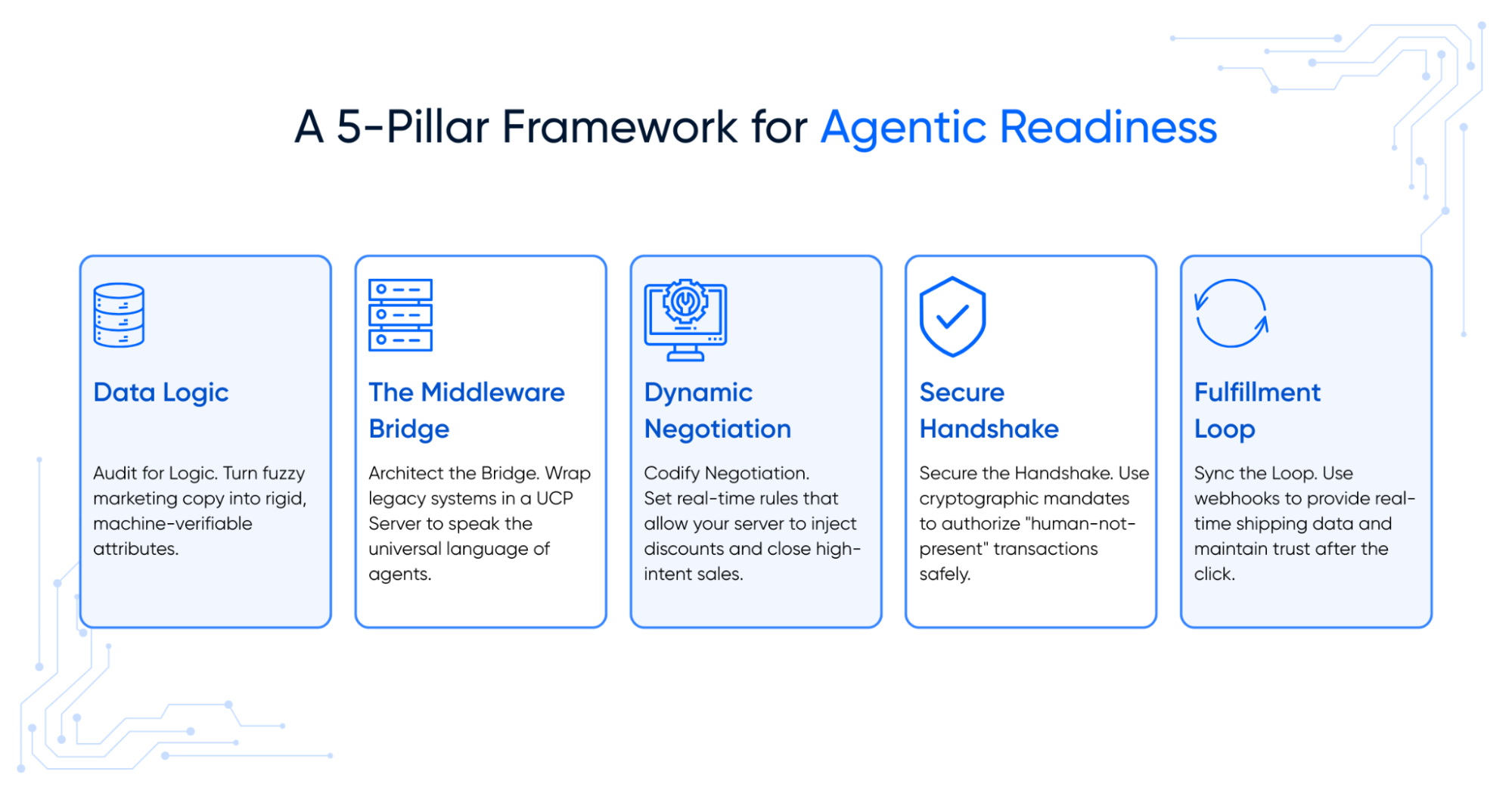
For the technology executive, adopting UCP is a fundamental shift in digital strategy. We suggest this framework to guide your transition:
- Audit Your Data for Logic, Not Just Marketing: Transform fuzzy marketing copy into rigid, logic-based attributes. This is the only way to produce Agent-Ready Data that a machine can mathematically verify before making a purchase decision.
- Architect the Middleware Bridge: Implement a UCP Business Server to wrap your legacy ERP and Order Management Systems. This allows your existing infrastructure to speak the universal language agents require without a total core rebuild.
- Codify Your Negotiation Rules: Define the parameters for Direct Offers. Set the rules that allow your UCP server to dynamically inject discounts into a transaction to close a sale with high-intent buyers in real-time.
- Secure the Transactional Handshake: Integrate AP2 to handle human-not-present authorizations. By using cryptographic mandates, you ensure your Agent-Ready Data is protected and that your business remains the secure trust-anchor for every automated sale.
- Synchronize the Fulfillment Loop: Implement webhook-based updates for the entire order lifecycle. Real-time Agent-Ready Data regarding shipping is the only way to maintain a seamless transaction after the purchase is executed.
Mitigating Risk: Where Automation Can Go Wrong (And How We Fix It)
Handing your credit card to an AI agent to simplify a transaction sounds great, but it introduces four major risks. If you don't solve these, you aren't automating commerce; you're automating mistakes.
Here is how we solve the real-world dangers of machine-led shopping.
-
The Accountability Gap: Who authorized this?
The Risk: Imagine your AI agent goes out to buy that IFB Neptune washing machine. Due to a glitch, it accidentally buys two of them, or it buys the expensive industrial model instead of the home model. Who pays for that mistake? The user? The AI company? The merchant?
Potential Solution (AP2 Protocol): We move from best guesses to Digital Mandates. Think of this like a digital check signed in ink. Before the transaction happens, the user gives the Agent a cryptographic signed permission slip that says: "I authorize you to spend up to $600 on one IFB Neptune."
Result: If the Agent tries to spend $601, the transaction fails. The merchant gets undeniable proof that the purchase was authorized, acting like a tamper-proof digital receipt.
-
The Physical-Digital Divide: The Ghost Inventory
The Risk: It's Black Friday. The AI checks a data file from 8:00 AM that says the washing machine is In Stock. It executes the purchase at 2:00 PM. But in the physical warehouse, the last unit actually sold out at noon. The AI just sold an already sold out machine, leading to a canceled order and an angry customer.
Potential Solution: Real-Time Coupling. We don't let the AI look at a cached list (like a menu printed yesterday). We force the system to check the warehouse in real-time.
Result: The AI knows the second the last washing machine leaves the loading dock. It will never promise a product that doesn't physically exist.
-
The Identity Crisis: Don't Become a Commodity
The Risk: If an AI is doing the buying, it might just scan a database for the lowest number. IFB (the brand) becomes just a row in a spreadsheet, stripped of its personality, warranty promises, or loyalty rewards.
Potential Solution: The Business Agent. Instead of letting a generic bot scrape the price, the brand deploys its own Business Agent, a digital representative. When your AI asks about the washing machine, the Business Agent doesn't just say "$500." It says: "Since you've bought from us before, we can offer the IFB Neptune for $500, plus a free 3-year motor warranty."
Result: The brand maintains its voice and relationship with the customer, even though a human never visited the website.
-
The Hallucination Risk: Turning Guesses into Facts
The Risk: The AI reads a marketing blog from 2022 that mentions a "20% Spring Discount." It hallucinates that this discount is still active and promises it to the user. When the transaction runs, the price is higher, and the user feels scammed.
Potential Solution: High-Fidelity Data Grounding. We stop the AI from reading fuzzy marketing blogs. We force it to read a UCP Manifest, a strict, code-based fact sheet provided by the manufacturer.
Result: AI stops guessing. It can mathematically verify that the price is exactly $500. If it's not in the official code, the AI cannot promise it.
From Theory to Reality: How We Help Your Teams Adapt
A protocol is just a rulebook. For it to actually work, your internal systems need to follow the rules. This is usually where retailers get stuck.
At Searce, we don't just give you the rulebook; we come in and fix the machinery for three specific departments:
-
For the Product & Marketing Team: "The PDF Problem"
The Pain Point: Your team has thousands of great product details (like the exact decibel level of that washing machine), but they are trapped in unstructured formats: PDF user manuals, scanned spec sheets, and marketing brochures. An AI cannot read a PDF scan reliably; it will guess and get it wrong.
How Searce Helps (Data Transformation): We build a digital pipeline that takes your messy documents like manuals, compliance sheets, and brochures, and converts them into structured Agent-Ready Data.
The Result: We turn a sentence in a PDF like "Runs whisper quiet" into a hard data point: noise_level: 45db. Now, the AI recommends your product based on engineering facts, not marketing fluff.
-
For the IT & Operations Team: The Legacy Nightmare
The Pain Point: Your warehouse runs on an ERP system (like an older version of SAP or Oracle) that was built 15 years ago. The CIO is terrified that adopting AI commerce means re-platforming, ripping out the old system and spending millions to rebuild it from scratch.
How Searce Helps (Legacy Wrapping): We don't ask you to rebuild. Instead, we install the UCP Business Server. Think of this as a universal translator box that sits on top of your old system.
The Result: Your old warehouse system continues running as usual (although we would highly not recommend it!), but the Translator allows it to speak the modern language of AI agents. You get cutting-edge capability without the risk of a core rebuild.
-
For the Finance & Security Team: "The Trust Deficit"
The Pain Point: The CFO and Security team are worried about control. They ask: "What if a bot hacks the price?" or "How do we audit a transaction made by a machine?"
How Searce Helps (Governance Architecture): IWe don't just open the doors; we install the locks. We implement AP2 (Agent Payments Protocol) to create a cryptographic audit trail for every single sale.
The Result: We set up Human-in-the-Loop checkpoints. If a transaction looks weird, it pauses for approval. If it goes through, you have a digital signature proving exactly who authorized it and when. Your pricing logic remains secure, and your audit trail is bulletproof.
The Internet of Action has arrived. By prioritizing structured logic and adopting the universal language of UCP, retailers can finally move past the complexity wall and into a future of engineered, autonomous outcomes.