The Platform That Was Supposed to Fix It
Author: Pravin Borade, Senior Vice President, Business Systems Engineering, Searce
Article 2 of 5: AI for Logistics that Shows Up in Your P&L
In Part 1, we established that Days Sales Outstanding (DSO) is built in your billing cycle, not your collections process. On a $500M freight book, carrying 8 to 16 days of unbilled status costs over $800,000 every year in silent financing drag before your collections team makes a single call.
In this article, we will see why the platforms you bought to fix that problem cannot fix it and why that is not a vendor failure.
You spent $3–8M on the Transportation Management System (TMS). You staffed the implementation. Your ops lead told the board that billing would be automated and manual headcount would come down.
Three years later, you have 40 people running exceptions.
Research from Gartner puts TMS adoption in mid-market freight above 70%. Average DSO across the same cohort: 48–55 days, unchanged over five years despite the platform investment. The platforms are working. The DSO is not moving. These two facts are not in contradiction and that is the problem.
The TMS automated the freight operation you wished you had. It did not automate the freight operation you actually run.
The Theory: Clayton Christensen and the category boundary
In his seminal book The Innovator's Dilemma, Clayton Christensen documented why dominant technology incumbents consistently fail against new entrants, not from complacency, but from rational management. Incumbents invest in sustaining innovations: improvements that make the existing product better for the existing customer. They optimize the core. They stop at the edges.
Disruptive innovations enter precisely at those edges, the use cases too complex, too marginal, or too non-standard for the incumbent to prioritise. They improve on dimensions the existing product does not even measure. And this is where they unlock value that sustaining platforms leave untouched.
The Modern Adaptation
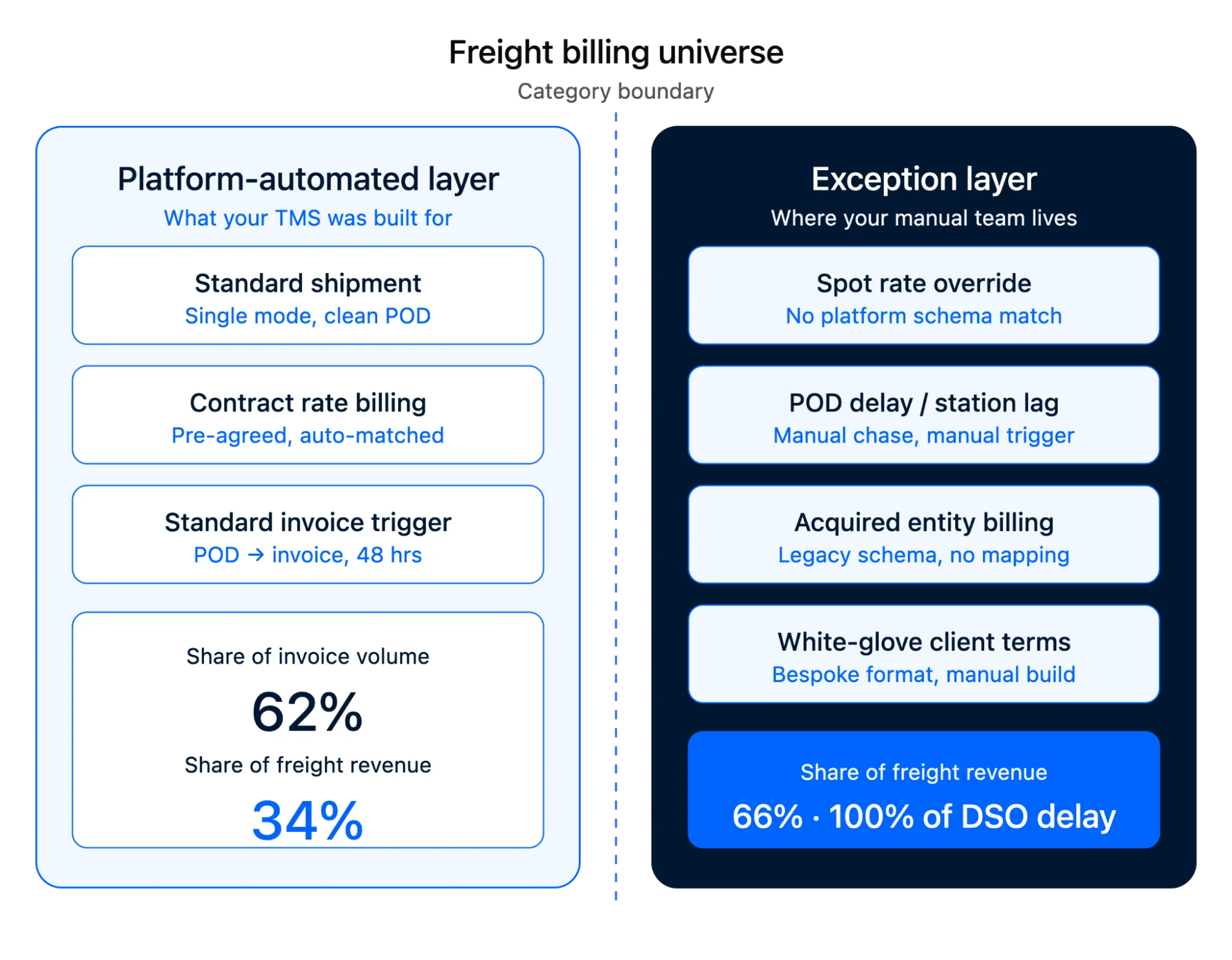
Christensen's original disruptors won by simplifying - cheaper steel, lower-cost storage. In freight billing, the unlocked value runs in the opposite direction. The cases that sustaining platforms cannot handle are not simple. They are the exception-dense cases: the spot-rate override, the POD delay at a specific station, the acquired entity whose billing schema never mapped cleanly to the platform. TMS platforms were designed to optimise standard freight throughput and they do that with genuine excellence. But standard shipments represent 62% of invoice volume and only 34% of freight revenue. The remaining 38% of volume, the complex, non-standard cases generate 66% of revenue and 100% of the billing delay.
There is a second force that sustaining platforms were not designed for. Mid-market 3PLs grow by winning contracts the largest players will not touch. They agree to unique terms, bespoke billing formats, and white-glove handling requirements for clients who need a more flexible partner. This is the right commercial strategy and it compounds the exception problem structurally. Every new client with non-standard requirements adds to the exception layer. The platform schema stays the same. The manual team grows to bridge the gap. Exception volume does not decrease as the platform matures. It increases, because the growth model that drives revenue is the same model that makes the exception layer unavoidable.
This is the category boundary. The TMS cannot cross it by design.
The Global Proof: What XPO built and what it means for mid-market operators
XPO Logistics, at $8B in North American freight revenue, made a deliberate architectural decision: they built a proprietary exception management and billing intelligence layer that sits above their TMS, not inside it. When a spot rate override occurs, when a POD is delayed, when an acquired station's billing falls outside the platform schema, XPO's exception layer captures it, classifies it, and routes it through an automated resolution path matched to that specific exception type. The TMS handles standard freight. The execution layer handles everything else.
The result: XPO's freight brokerage division ran a DSO of 38 days against a mid-market median of 51 days, a 13-day advantage. On an $8B freight book, that is over $280M of working capital. Stifel analysts attributed the delta specifically to billing cycle efficiency, not collections discipline.
The instinctive executive objection: "XPO built that layer with $8B of revenue. That investment is not available to us." The objection inverts the logic. XPO built the exception layer when it was a $2B operator because at $2B, the exception layer was already the constraint on growth. And here is the relevant point for mid-market operators: you do not need to build what XPO built. That is exactly what we do. We come in and build the execution layer above your existing TMS, the same architectural move XPO made without replacing your record system and without an 18-month implementation.
(To see what this looks like in production including a 45% faster time-to-revenue outcome for a global logistics operator, visit the Swivel-Chair Billing Crisis case study on our logistics practice page.)
The Reality: What we found and what we built
We run billing operations for a major global 3PL, a CMA CGM group company processing 2.5 million invoicing transactions per year across multiple modes and acquired entities.
When their TMS implementation completed, the vendor's stated outcome was 80% billing automation. The platform delivered on that commitment for standard shipments. The problem: standard shipments were 62% of transaction volume but 34% of revenue. The remaining volume, multi-modal shipments, spot-rate overrides, acquired-station billings that never fully mapped to the platform schema generated 66% of revenue and 100% of the billing delay. A team of 38 people were bridging the gap with institutional knowledge.
We instituted a parallel exception intelligence layer: a purpose-built execution system that captured every non-standard billing trigger, classified it by exception type, and routed it through an automated resolution path matched to that category. We did not replace the TMS. We built what the TMS category boundary excluded. We build the execution layer while your record layer stays the same.
Within six months: 71% of previously manual exception billings moved to automated resolution. The team of 38 reduced to 14 through redeployment, not redundancy. Invoice accuracy on exception billings improved from 84% to 97%. The acquired divisions carrying 16 days of unbilled status came down to under 6.
(The downstream impact on claims and disputes including 80% faster claim resolution is documented in the Claims & Dispute Resolution module on our logistics practice page.)
The CEO's Playbook: The exception cost audit
The TMS will not fix your exception billing problem. The next platform upgrade will not fix it. The sustaining innovation optimises the standard process and stops at the category boundary by design.
The Mandate: Run the Exception Cost Decomposition
Ask your billing operations leader two questions before your next ops review: "What percentage of our invoices touch a manual exception step before issuing?" and "What is our average billing cycle time on exception shipments versus standard?" If the answers come back as estimates or require a query that takes more than a day to produce, you are managing the standard process while the exception layer runs on institutional memory.
The Surgical Tool: The Exception Drag Formula
Exception invoice volume × Avg. delay vs. standard × Daily revenue rate
× Cost of capital = Annual working capital drag

Platform ROI Gap = (Implementation cost amortised + Annual licence)
                   − (Headcount eliminated × Fully-loaded cost per head)
Daily revenue:          $400M ÷ 365 = $1.10M/day
Exception delay:        9 days vs. 2 days standard = 7-day drag
Working capital idle:   $1.10M × 7 × 0.35 = $2.7M
Annual drag at 6%:      $2.7M × 6% = $162K/month = $1.9M/year

Platform ROI Gap:
Amortised cost + licence:  $1M + $800K = $1.8M/year
Headcount eliminated:      8 FTEs × $95K = $760K/year
Unrecovered:               $1.04M/year

Total annual cost of the category boundary: $2.94M/year
Run your own numbers. The only variable is whether your billing team can give you the exception rate and delay figure with enough precision to populate the formula. If they cannot, that is itself the finding.
The Summary
TMS and ERP platforms are well-engineered solutions that do exactly what they were designed to do. The 40-person manual exception team in your billing operation is not an implementation failure, it is a category boundary. The predictable, structural consequence of deploying a sustaining innovation against a problem that lives outside its design envelope.
The CFO who understands this stops looking for a better TMS to fix the exception problem. She asks what it would cost to build the execution layer the TMS will never provide and what it is already costing her not to.
Is your platform investment delivering its ROI case or is it funding a manual exception operation that silently compounds your DSO every month?
Next time in Part 3: Your board mandated AI. You deployed it. You have the dashboard, the QBR slide, the executive briefing. Your CFO's working capital position has not moved. Next week we look at why most logistics AI investments disappear into the P&L without a trace.