Your DSO Is Lying to You
Author: Pravin Borade, Senior Vice President, Business Systems Engineering, Searce
Why your collections team isn't the problem and where millions in working capital are actually hiding.
Article 1 of 5: AI for Logistics that Shows Up in Your P&L
Your collections team is not your DSO problem.
Most logistics and finance leaders will push back on that sentence. When Days Sales Outstanding (DSO), the average number of days it takes to collect payment after a sale sits at 45 to 60 days against net-30 payment terms, their knee-jerk instinct is predictable: tighten collections, escalate calls earlier, add headcount, and push harder.
It is the wrong diagnosis applied with great discipline. It's like blaming a waiter for a table occupying a seat for two hours because of a delayed check, when in reality the kitchen took an extra hour just to get the appetizers out to the table. The waiter can't bill for a meal that hasn't been served.
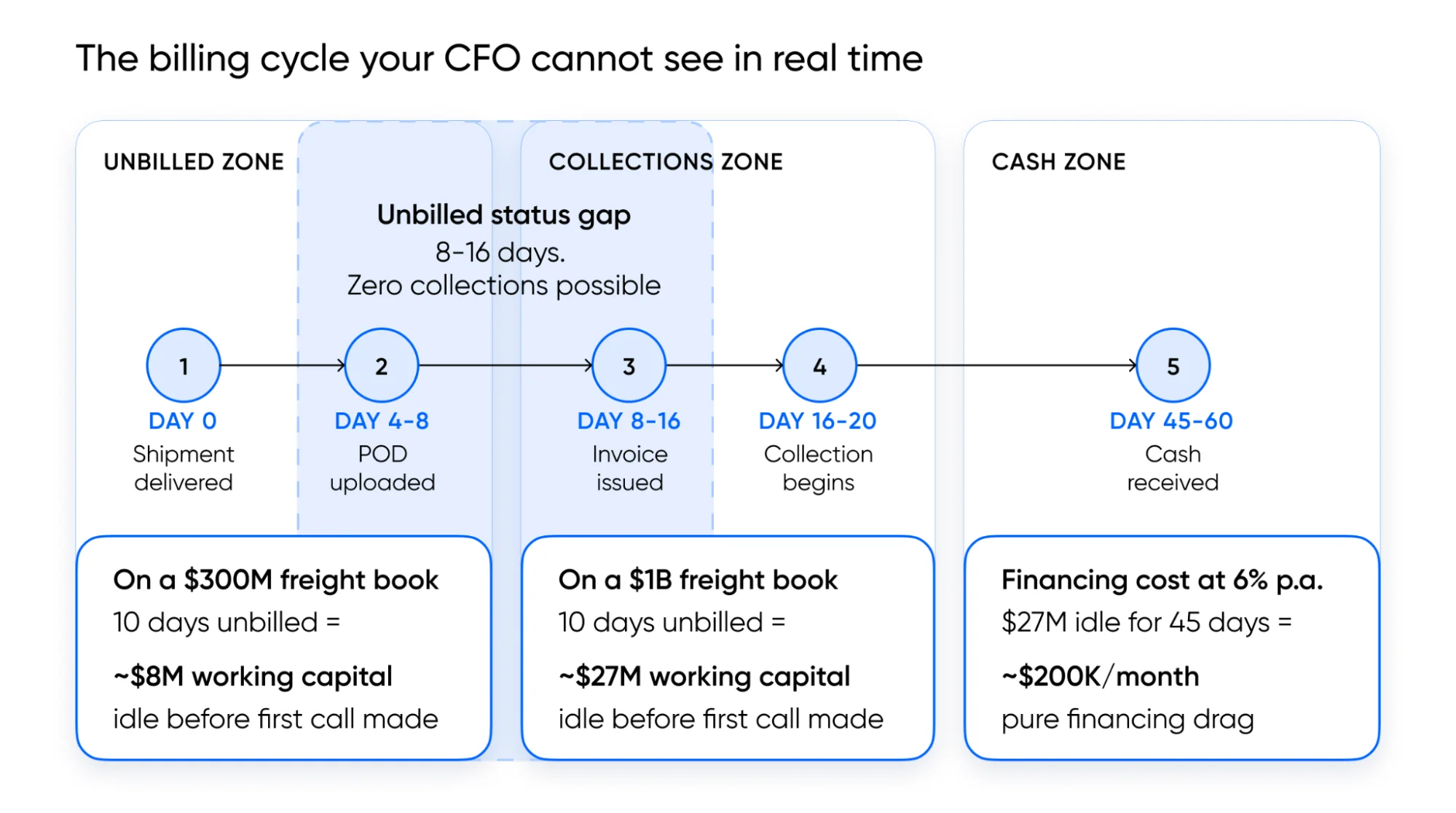
Here is the number that reframes it. On a $500M freight book, the average mid-market 3PL (Third-party Logistics provider) is carrying 8-16 days of unbilled status at any point in time. Revenue earned. Shipments delivered. Invoices not yet out the door. That is $11–22M of working capital sitting idle before your collections team has made a single call, before a single payment term has elapsed, and before a single dispute has been raised.
Your DSO is not a collection number. It is a billing cycle number. And most of it is built before your collections process begins.
The Theory: Eli Goldratt and the constraint your P&L hides
In his business classic, The Goal, Eli Goldratt established the principle that governs every complex operational system: throughput is determined by the constraint, not the average. You cannot increase a system's total output by speeding up a part of the process that isn't the primary bottleneck. Every hour spent accelerating a non-bottleneck stage is an hour that does not move the number that matters.
Imagine a massive 8-lane highway leading to a destination. The cars can drive 80 mph on the open road, but right in the middle, they must pass through a single, manual 1-lane toll booth.
Hiring faster drivers or forcing cars to drive 100 mph after the toll booth won't get anyone to their destination faster. The single toll booth dictates the arrival time of every car.
Goldratt wrote this about factory floors. But his logic maps precisely onto the order-to-cash cycle of a freight forwarder or 3PL, and most operators are optimising the wrong stage entirely. They are desperately trying to tune up the engine (collections) while ignoring the massive traffic jam at the toll booth (billing).
The Modern Adaptation: Physical vs. Informational Constraints
Goldratt's original constraints were physical - a machine, a shift schedule, a floor with a fixed throughput ceiling. Physical constraints are visible. They show up on production reports. Managers walk past them.
In a modern multi-modal freight operation, the constraint is informational: it is the gap between when a shipment is delivered and when that event - with all its associated documentation, rates, and exceptions resolves into an invoice.
That gap is not visible on any standard report. It does not appear on a DSO dashboard. It is distributed silently across stations, modes, and manual exception queues, compounding with every shipment that touches a human hand before it triggers billing.
This is why informational constraints are more dangerous than physical ones: they are invisible until someone decides to measure them directly. The CFO sees DSO, the aggregate output of a process she cannot see. She does not see the eight days of unbilled lag that inflated that output before her collections team picked up the phone. And because she cannot see it, she cannot manage it. She optimises the end of the cycle while the constraint sits untouched at the beginning.
The Global Proof: How C.H. Robinson sees what your CFO cannot
C.H. Robinson, the largest freight broker in the US at $18B in revenue, built its Navisphere platform around a single operational principle: billing intelligence must be real-time, not retrospective.
When a load is delivered, the system sees it. When POD is confirmed, the system automatically triggers the invoice. The finance team does not wait for a monthly DSO report, they have a live view of billing status, by shipment, every day.
The mid-market competitors who did not build this capability tell the same story: revenue grew, and DSO grew with it. Not because collections worsened, but because the manual exception processes that managed billing did not scale. Industry benchmarks from the Council of Supply Chain Management Professionals document that top-quartile 3PLs carry DSO 12–18 days lower than the industry median. The delta is not collections performance. It is billing cycle architecture.
The instinctive executive objection: "C.H. Robinson built Navisphere with $18B of revenue behind it. That is not a comparable investment." This inverts the causality. C.H. Robinson did not build billing intelligence because it was large. It scaled in part because it built billing intelligence when it was smaller and the visibility it created compounded over time into a structural cost advantage. The technology required to decompose unbilled status by mode, station, and root cause is not a large-enterprise problem. It is a data architecture decision. The constraint is not budget. It is the decision to look.
(For a detailed view of what AI-native invoice reconciliation looks like in production, including the 95% touchless billing accuracy benchmark, the Searce logistics practice page has the full breakdown.)
The Reality: What we found inside a $10B global freight operation
We run billing operations for a major global 3PL company, processing 2.5 million invoicing transactions per year across multiple modes and acquired entities.
When we first mapped their billing cycle, everyone expected the problem to be disputes or write-offs. The numbers said otherwise - dispute rates were within industry norms, write-offs were contained, and the collections team was performing.
The actual finding was upstream and invisible to the standard reporting stack: on one of their recently acquired divisions, we found 16 days of unbilled status. Revenue delivered. Accruals booked. Invoices not issued. On the legacy platform, the same metric was 4 days. The 12-day gap between them had nothing to do with collections, it traced directly to three manual intervention points in the acquired division's POD workflow that were silently delaying invoice triggering on every single shipment processed through that platform.
We instituted a real-time unbilled status monitor - decomposed by mode, station, and root cause alongside an automated exception triage layer that eliminated the three manual trigger points. Within 90 days, we moved the acquired division from 16 days unbilled to under 6. The CFO had a daily number, not a monthly report. She could see, for the first time, which stations and lanes were generating billing delay and act on it the same week, not the same quarter.
The outcome: 30% reduction in overdue AR across the book. 14-day improvement in payment cycle time. Invoice delivery averaging under 48 hours from trigger. Not a pilot. A production operation that still runs today.
The CEO's Playbook: The unbilled status audit
You cannot manage what you cannot measure. Most 3PL finance teams measure DSO - the aggregate output of the billing cycle without decomposing the inputs that built it. That is equivalent to managing a manufacturing P&L by revenue alone, without ever seeing unit cost by product line. The number is real. The picture is incomplete.
Step 1 - The Mandate: Run the Unbilled Status Decomposition
Before your next monthly finance review, ask your CFO one question: "What is our average unbilled status - by mode, by station, and by root cause - right now, today?"
If the answer takes more than 24 hours to produce, you have found your constraint. Not in your collections process. Not in your dispute resolution workflow. In your billing cycle, upstream of where you have been looking.
Step 2 - Calculate Your Hidden Drag
Every day an invoice sits unsent, your company is providing an unapproved, interest-free loan to your customer while paying interest on your own credit lines to fund it. Use this standard formula to measure your financial loss:
Daily revenue × Unbilled days × (Cost of capital ÷ 12) = Monthly financing drag
Daily revenue:         $500M ÷ 365 = $1.37M/day
Unbilled days:         10
Working capital idle:  $1.37M × 10 = $13.7M
Monthly drag at 6%:    $13.7M × 0.5% = $68,500/month
Annual drag:           $822,000/year

At 16 days unbilled:   $1.3M/year — before a single collection call is made.
At $1B revenue:        $2.6M/year — structural, silent, and entirely recoverable.
Run your own numbers. The formula is identical. The only variable is whether you know your unbilled days precisely enough to put them in it.
If your unbilled lag is 16 days, that drag jumps to $1.3M per year, money lost entirely before your collections team makes their first phone call. At $1B in revenue, you are burning $2.6M annually in silent, recoverable capital.
The Summary
DSO is the output. Unbilled status is the input. Most 3PL finance teams manage the output while remaining structurally blind to the input and their collections process bears the cost of a problem it did not create and cannot fix.
Goldratt's constraint logic is exact here: you cannot improve throughput by optimising non-constraints. If your billing cycle is generating 8–16 days of invoice lag before your payment terms even begin to run, no amount of collections discipline recovers that gap. The only lever is visibility, real-time, decomposed, actionable at the stage where the problem is built.
The CFO who knows her unbilled status by station and root cause today is running a materially different business than the CFO who sees a DSO report three weeks after the month closes.
Both are managing the same freight book. Only one of them is managing it in real time.
Which one is making decisions about your working capital?
Next week in Part 2: You bought the TMS. You staffed the implementation. Your ops team told you billing would be automated. Three years later, you still have 40 people running manual exceptions. Next week we look at why legacy transportation management systems fail to automate billing and why it isn't a software vendor problem.