One Video, 6 Weeks, A Dozen Languages: How a Leading Pan-India Retail Chain Rebuilt Corporate Training for a Multilingual India
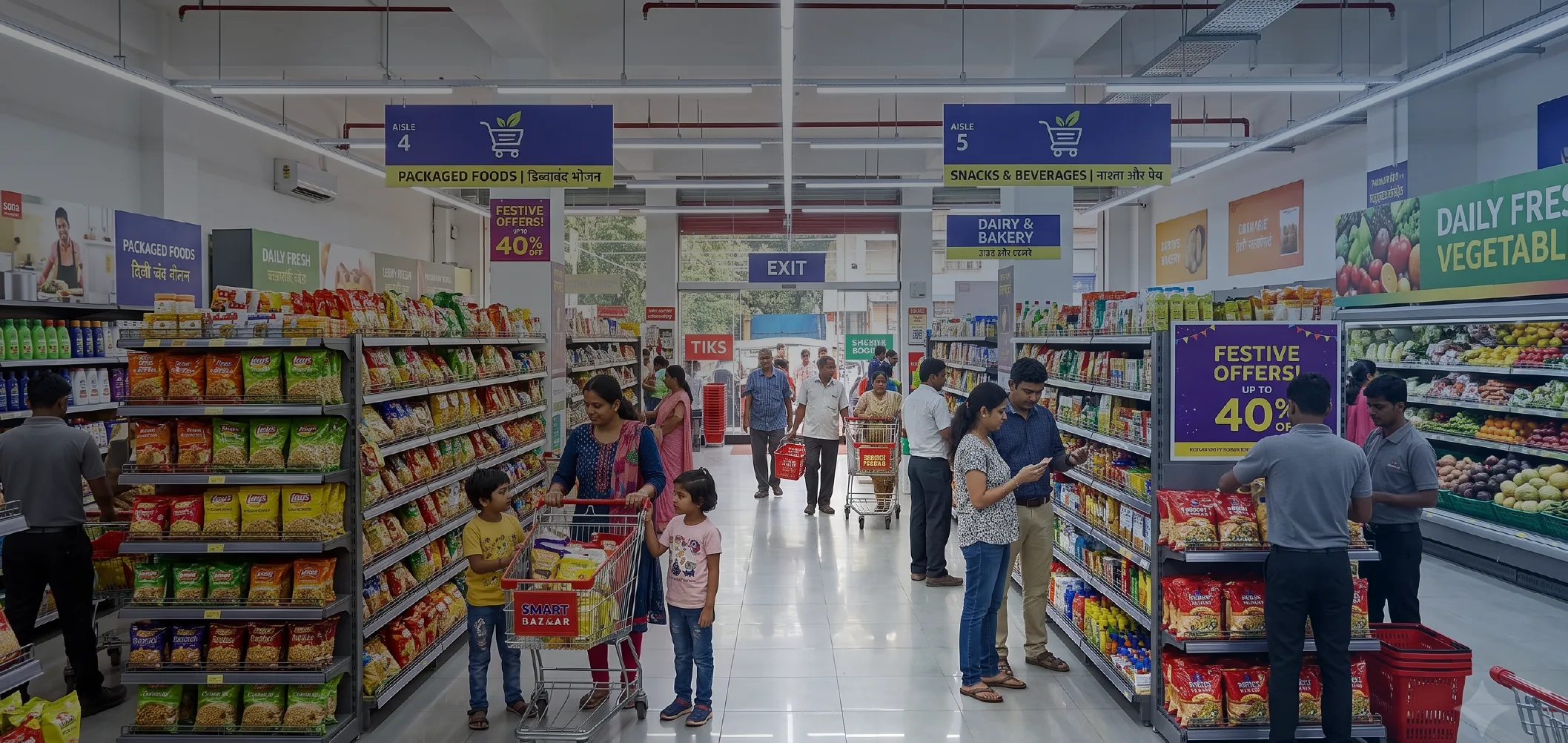
Picture a safety training video shot in English, sitting in a queue, waiting to reach store staff across the country who don't speak English at all. That wait used to be the real cost of running a pan-India retail business: every video meant manual transcription, manual translation, manual dubbing, and manual re-syncing, one language at a time. By the time a module reached its fifth regional language, the training need behind it had often already moved on.
Speed wasn't the only problem. Retail has its own vocabulary, and a generic AI translator will happily turn 'SKU' or 'inventory' into something meaningless on the store floor. On-screen text had to land back on the exact same pixels it started on. And translated audio rarely runs the same length as the original — a Hindi voiceover might need 15% more time to say what English said in ten seconds, and without correcting for that, voice and video quietly drift apart.
The Solution: Polysync, an AI Pipeline That Localizes Video End to End
Searce built Polysync for this leading retail chain — a serverless, event-driven platform on Google Cloud that takes an English training video in and returns a fully dubbed, visually accurate regional version out, with one human checkpoint in between.
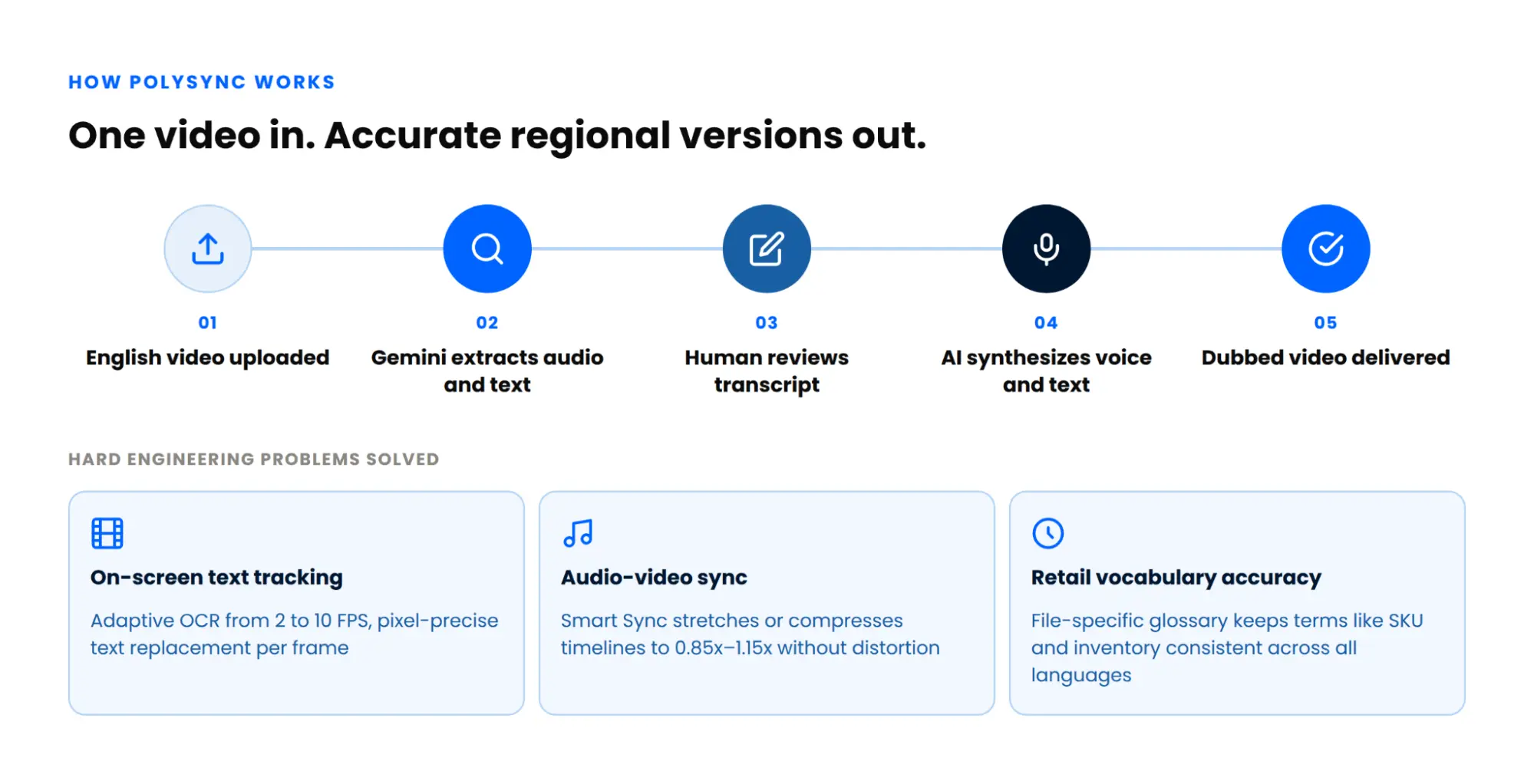
Gemini first extracts spoken dialogue and on-screen text from the raw video, muted before OCR runs, so the AI never confuses what's said with what's written. A retail subject-matter expert then reviews the draft transcript in a purpose-built tool, with Gemini offering context-aware rewrite suggestions so retail terms stay retail-accurate. Once approved, the synthesis engine takes over: Cloud Vision tracks the exact pixel coordinates of the original text, Cloud Text-to-Speech generates a voiceover matched to the original speaker, and FFmpeg's "Smart Sync" logic stretches or compresses audio and video until they align perfectly, without sounding distorted. The finished video lands automatically in a structured Google Drive folder, and a Google Chat notification tells the right team it's ready.
Everything runs as independent Cloud Run microservices, so a long AI job never blocks anyone else's interface. Firestore tracks every video's status through the pipeline, and because this handles proprietary training content, the whole platform sits behind Identity-Aware Proxy and Cloud Armor — zero-trust access restricted to the client's own corporate IP ranges.
The Hard Engineering Problems
Matching moving on-screen text meant adapting the OCR scan rate on the fly, shifting from 2 frames per second up to 10 the moment animation is detected. Keeping translated text readable meant calculating the 98th-percentile background color at pixel level before "baking" it onto each frame. And solving sync meant treating audio and video as two independently adjustable timelines, so nothing ever sounds artificially rushed or stretched.
Quantifying the Impact
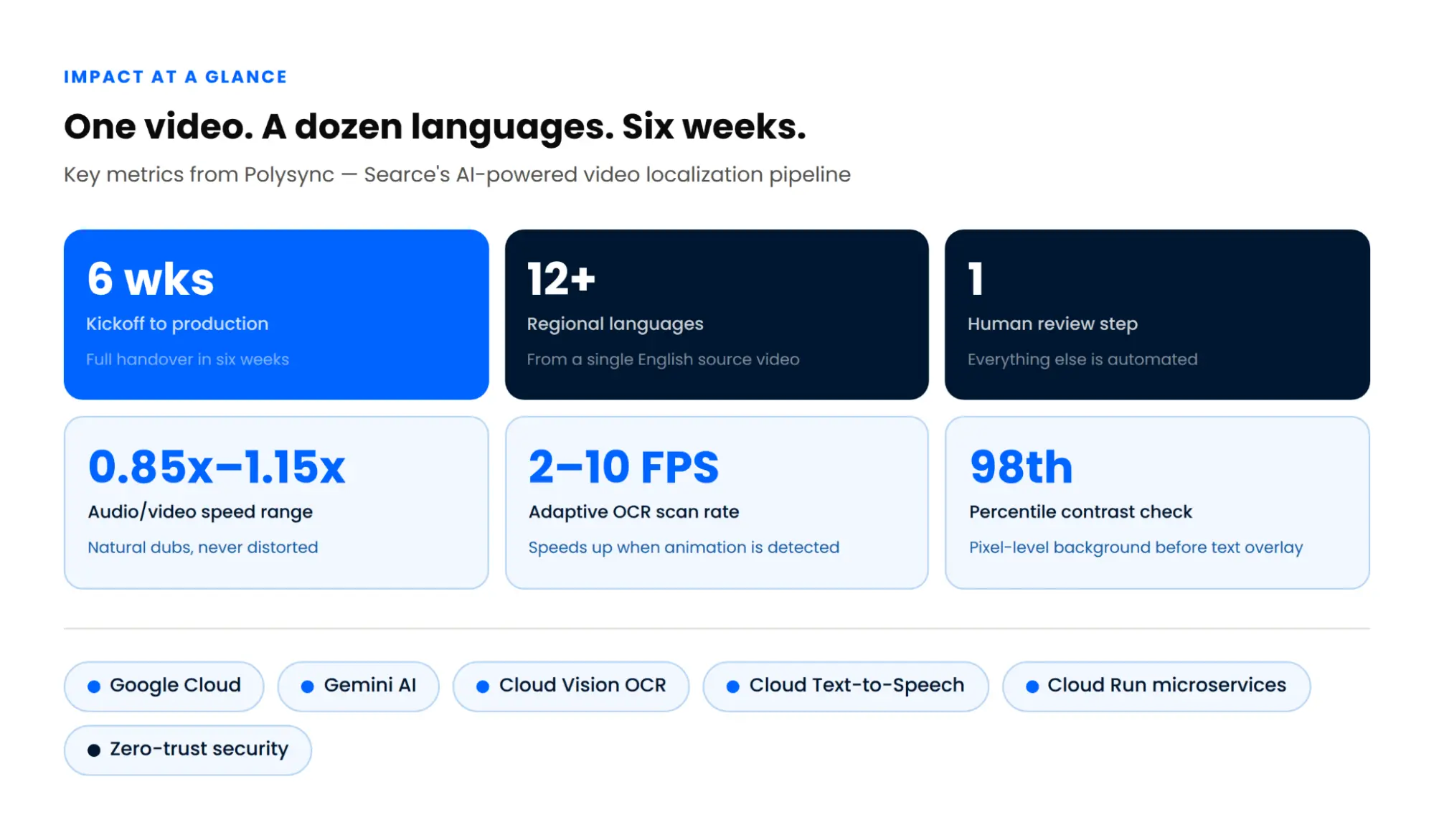
- 6 weeks from project kickoff to full production handover
- 0.85x–1.15x audio/video speed range, keeping every dub natural rather than distorted
- 2 to 10 FPS adaptive OCR scanning, automatically speeding up when on-screen animation appears
- 98th-percentile background contrast calculated for every overlaid frame
- Multiple regional Indian languages generated from a single English source video
- Zero-trust access enforced platform-wide via Identity-Aware Proxy and Cloud Armor
What Changed for the Business
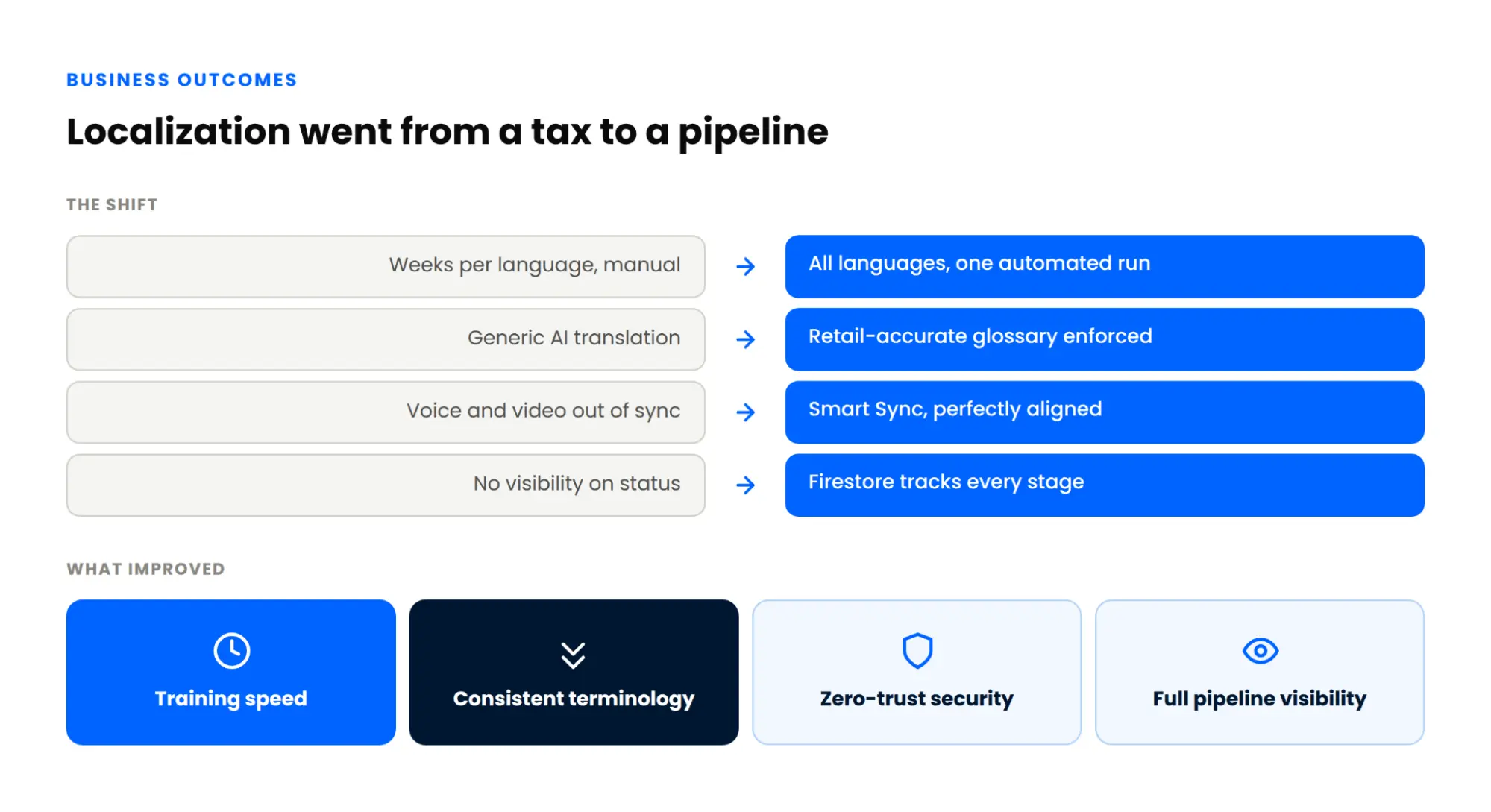
Training content that once waited weeks for a single regional dub now moves through one automated pipeline with a single human review step. A strict, file-specific glossary keeps technical retail terms consistent across every language instead of drifting with each translator. And because Firestore tracks state at every stage, nothing gets lost between an upload, a review, and a finished video — the entire chain from raw footage to a delivered file is visible end to end.
Conclusion
Localization used to be a tax. Every regional language cost this retail giant weeks, and the bill never got smaller. Polysync turned that tax into a pipeline: one video in, a dozen accurate, visually faithful regional versions out, retail vocabulary intact, every single time.
Ready to localize your own content library at the speed your business actually moves? Let's talk about what an AI-driven media pipeline could look like for you.
more case studies