96% Recall: How a Leading Mumbai Power Utility Automated Grid Safety Across 6,00,000+ Assets in Mumbai
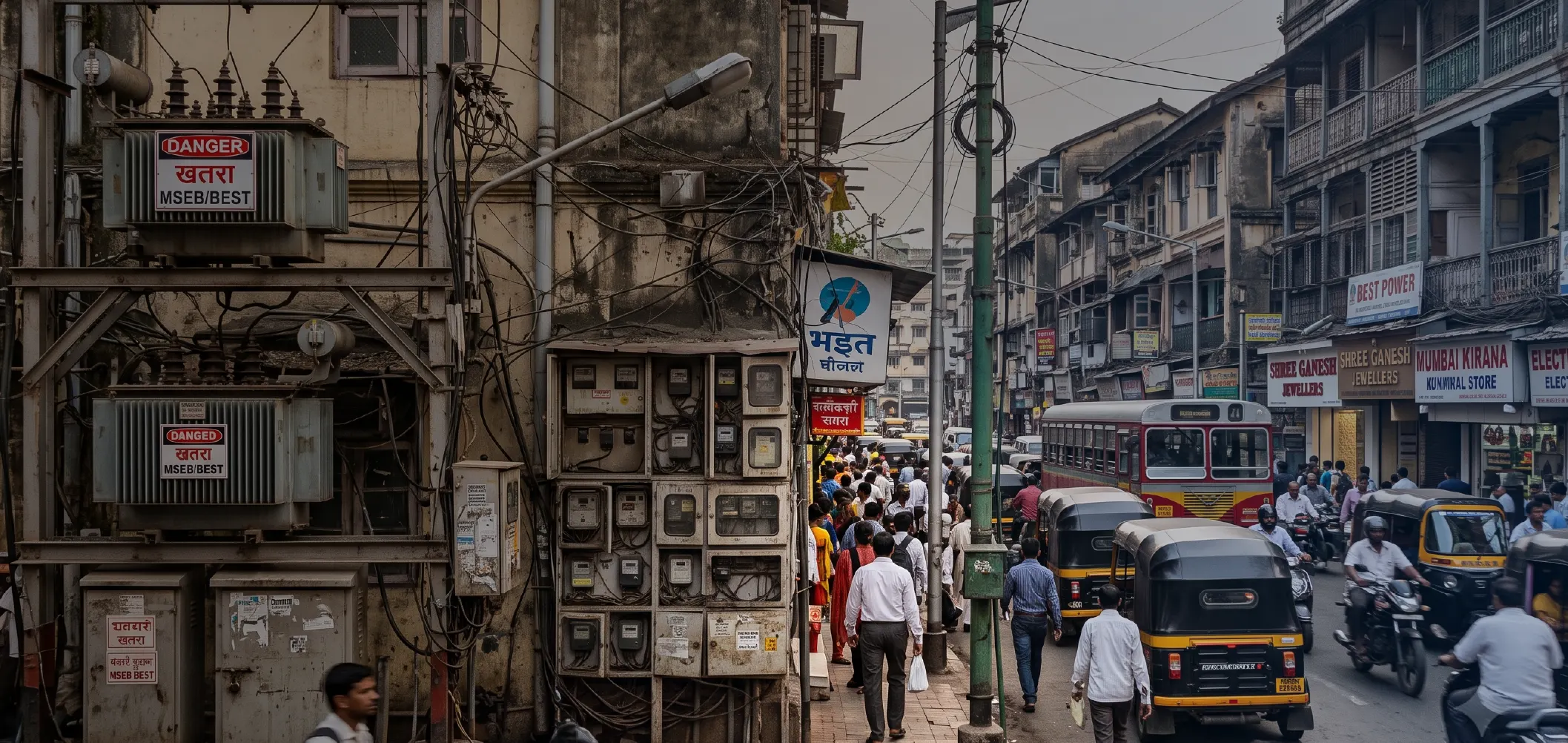
Every time the lights go out in Mumbai, it's not just an inconvenience, it's a cost. A cost in customer trust, in revenue left uncollected, in crews stretched thin, and in the very real risk to the people sent out to fix it. A leading electricity distribution company powers one of the world's most densely populated cities, keeping watch over 626,868 physical assets, meter cabins, streetlight poles, transformers, and substations. For years, the only way to know if any of it was safe was to send someone to look at it in person.
That approach was quietly running out of road. Manual inspection couldn't keep pace with a grid this size, one technician's "safe" was another's "hazard," and problems like an overheating wire or a makeshift fix often went unnoticed until they caused a failure, or a fire. Monsoons made ground-level checks genuinely dangerous exactly when the grid needed attention the most. And every outage meant hours of root cause analysis, because what the company's records said existed in the field often didn't match reality. The result: slower repairs, frustrated customers, and safety risk that no amount of hiring could fully solve.
The Shift: From Sending People to Deploying an Autonomous Digital Workforce
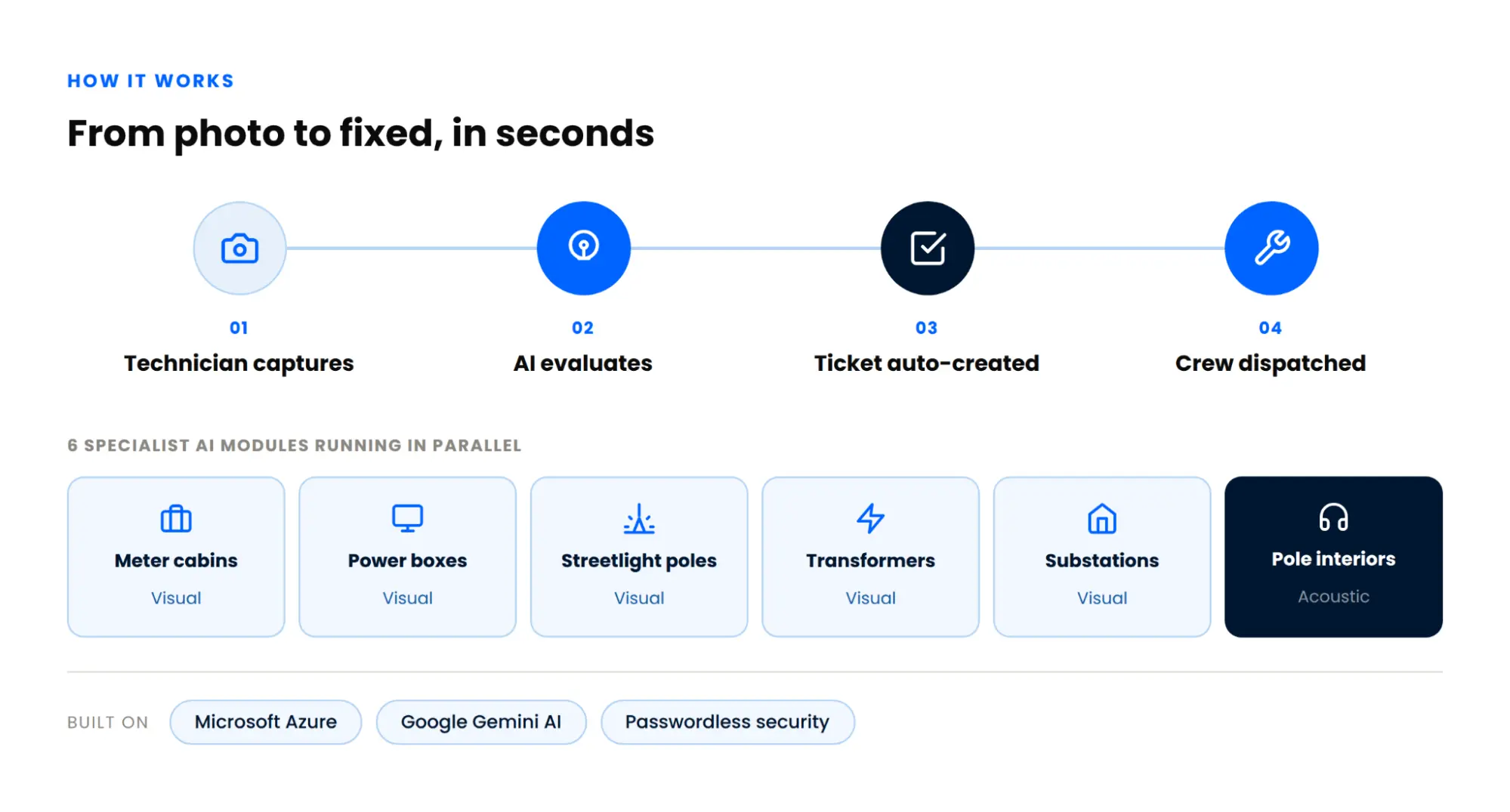
Instead of adding more inspectors, this utility and Searce built something that could see, judge, and act on its own, an Agentic AI system that behaves less like a reporting tool and more like a tireless digital field team. A technician snaps a photo or records a sound; the AI evaluates it, decides whether it's a real hazard, and automatically opens a repair ticket: no manager, no paperwork, no waiting in a queue.
This "digital workforce" runs six specialized checks in parallel across the grid: it inspects meter cabins for wiring risk, scans street-level power boxes for hotspots, checks streetlight poles for structural damage, watches transformers for oil leaks and overheating, audits substations, and even "listens" to the sound of a hammer tap to catch corrosion hiding inside a pole, a hazard no camera could ever see. Underneath, the system runs on Microsoft Azure and Google's Gemini AI, built inside a locked-down, passwordless security environment, because grid data isn't something you can afford to leak.
Getting this right in the real world wasn't trivial. Field photos are blurry and inconsistent. Mumbai's traffic and construction noise nearly drowned out the acoustic signals the AI needed to hear. And some of the most dangerous failures are also the rarest, with barely enough real-world examples to learn from. The team solved this not with more data, but with smarter guidance to the AI itself, teaching it to recognize danger it had almost never seen.
The Business Outcome
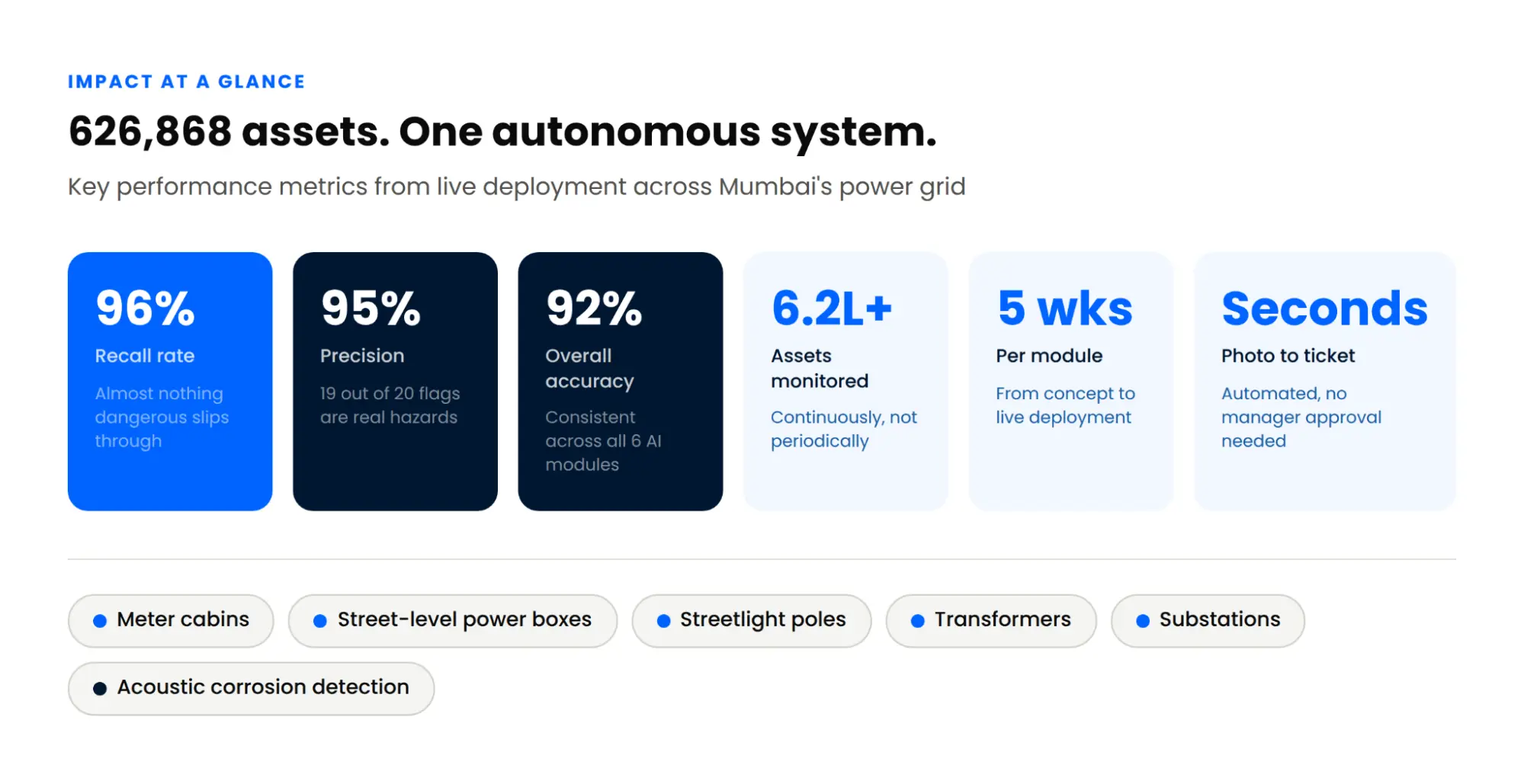
- 626,868 assets now under continuous, automated watch instead of periodic manual sampling
- 96% recall, almost nothing dangerous slips through undetected
- Seconds, not hours, from a technician's photo to an automatically created repair ticket
- 95% precision, when a hazard is flagged, it's real 19 times out of 20, so crews stop wasting time on false alarms
- 92% overall accuracy, applied consistently across every one of the six modules
- Each of the six AI modules went from concept to live deployment in five-week sprints
What Changed for the Business
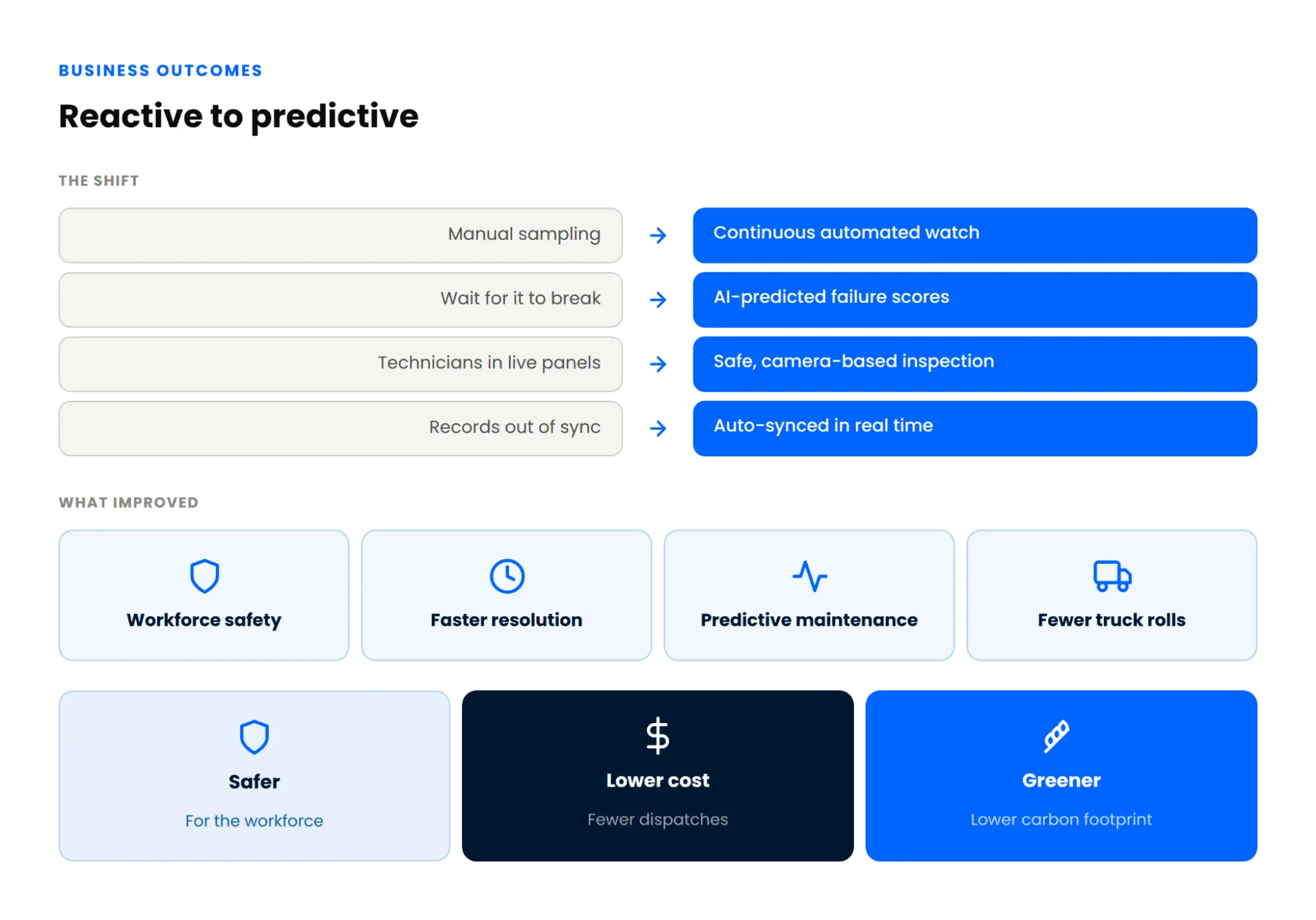
The impact goes beyond faster fault detection. Maintenance shifted from reactive ("wait for it to break") to predictive, with AI-generated failure risk scores letting crews fix problems before they cause outages. Technicians are pulled out of harm's way, no longer required to climb unstable poles or open live panels for routine checks. Field records and company systems now stay in sync automatically, closing a gap that used to cause billing and inventory errors. And with fewer unnecessary truck rolls, this utility also cuts its operating costs and its carbon footprint, a rare case where safety, cost, and sustainability all move in the same direction.
Conclusion
At this scale, "inspect everything" was never something more people could solve, it needed a fundamentally different approach. By turning AI from a passive tool into an autonomous decision-maker, this leading power utility replaced reactive firefighting with predictive, self-managing grid operations, safer for its workforce, faster for its customers, and built to scale as the city keeps growing.
Ready to turn your field operations into an autonomous, self-healing system? Let's talk about what an Agentic AI pipeline could look like for your business.
more case studies